Networking Development Engineering
  • HOME
  • SOLUTIONS
  • USE CASES
    • Closed-Loop Diagnostics
    • From Data to Insight
    • Inventory Sync
    • Device Onboarding
  • CONTACT US
  • BLOG
  • More
    • HOME
    • SOLUTIONS
    • USE CASES
      • Closed-Loop Diagnostics
      • From Data to Insight
      • Inventory Sync
      • Device Onboarding
    • CONTACT US
    • BLOG
  • HOME
  • SOLUTIONS
  • USE CASES
    • Closed-Loop Diagnostics
    • From Data to Insight
    • Inventory Sync
    • Device Onboarding
  • CONTACT US
  • BLOG

Bridging the Gap Between Inventory and Reality

Automated audit and remediation signaling for NetBox and Infoblox.

The Problem: Inventory Drift Maintaining a "Source of Truth" (SoT) like NetBox is only valuable if the actual network state reflects it. A common operational gap occurs when devices are provisioned in NetBox but lack corresponding Host records in Infoblox. This drift isn't just a data entry error—it’s a root cause for failed deployments, monitoring blind spots, and hours of manual troubleshooting. Manual audits are slow, prone to human error, and obsolete by the time the report is finished. 
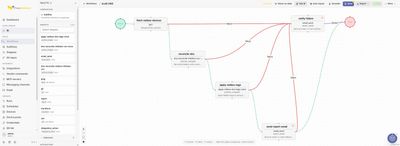
Execution Logic

How It Works

Flow Weaver automates this audit using a closed-loop workflow (internal ID: auditv01110). The process moves from data gathering to classification and, finally, to operational signaling:


  • Discovery: The workflow queries NetBox to pull all devices with an "Active" status, specifically capturing their names and primary IP addresses.


  • Validation: It performs a cross-system lookup in Infoblox, searching for Host records that match the NetBox device names.


  • Classification: Logic nodes compare the results. If a match exists, the device is marked as In Sync. If not, it is flagged as Missing DNS.


  • Operational Tagging: Instead of just generating a passive report, the workflow writes back to NetBox. It applies the tag dns-verified or missing-dns to each device. This turns a simple audit into machine-readable intent that other automation scripts can act upon.


  • Artifact Distribution: The system generates a timestamped CSV report and emails it to the infrastructure team, providing a clear audit trail.

The Interactive Session with Flow Weaver

Evolution of the Reconciliation Pipeline

Initial Iteration: Functional Mapping

Optimized Logic: Explicit Output Mapping

Optimized Logic: Explicit Output Mapping

This version established basic connectivity between NetBox and Infoblox but contained a technical flaw: implicit variable handling. The report_date variable, required for the email subject line, was nested within the internal logic of the CSV generation node. In production environments, this often leads to scope-related reference errors, as the notification service cannot retrieve the variable if it hasn't been promoted to the flow's global context. 

Optimized Logic: Explicit Output Mapping

Optimized Logic: Explicit Output Mapping

Optimized Logic: Explicit Output Mapping

The final design implements a structured return pattern to ensure pipeline stability. The CSV node was reconfigured to explicitly deliver two independent outputs: the file (csv_artifact) and the metadata (report_date). By decoupling the timestamp from the file generation and elevating it as a top-level output, subsequent nodes are guaranteed access to the data without lookup failures. This adjustment transforms a functional prototype into a resilient, production-ready automation. 

Actionable Audit Output

The auditv01110 workflow produces a structured CSV artifact that captures the delta between the Source of Truth and the active DNS environment. Each record identifies the device, its IP address, and the specific synchronization status—such as In Sync or Missing DNS. This provides infrastructure teams with a verifiable audit trail and a direct list of required remediations, ensuring that naming conventions and record accuracy are maintained at scale. 

Deterministic Governance for Infrastructure Data

Static audits are no longer sufficient for maintaining modern network infrastructure. This reconciliation workflow demonstrates how Flow Weaver bridges the operational gap between intent (NetBox) and implementation (Infoblox) by automating the identification and signaling of data drift. 

By converting audit findings into machine-readable tags within the Source of Truth, the process moves beyond simple reporting into active operational enforcement. This ensures that your inventory remains a high-fidelity foundation for the rest of your automation stack, significantly reducing the risk of outages caused by stale or inconsistent DNS records. 

Schedule a Technical Deep Dive

Subscribe

Sign up to hear from us about solutions and new releases.

Copyright © 2026 NetworkingDev - All Rights Reserved.

This website uses cookies.

We use cookies to analyze website traffic and optimize your website experience. By accepting our use of cookies, your data will be aggregated with all other user data.

DeclineAccept